

Earth Science Computational Science Technical Blueprints Example Applications Biogeo Adjoint Ocean Ecosystems Realtime Inversion Getting Started Sites Available software Status People FAQ Mailing Lists Quick Links Contact Us Sponsors Search |
 |
|
Logging While Drilling (LWD) holds the promise of providing near real-time formation information for drilling decision making. These capabilities are increasingly valuable as expensive deep water reserves are targeted. ERL currently focuses on expanding the understanding of the wave physics of sonic measurements in this environment which will impact the development of new tools and processing algorithms. At ERL, grid computational modeling of LWD tools complements the ultrasonic laboratory measurements on scaled tools. An in-house MPI-C finite difference code is used to model an LWD tool firing in a sandstone formation. The tool has sections for the source and receivers separated by a spacer. In the experiment shown below, the spacer has holes at various angles which may attenuate undesirable guided waves in the tool. The finite difference model is 3D, and includes water in the borehole, a formation (here, sandstone), and source and receiver transducers set in a steel tool. A fine grid sampling is needed to represent the details of the tool structure. Such a fine grid would require nearly 150 Gigabytes of RAM memory to run if it extended throughout the formation. By using a variable grid, the required memory is kept under 5 Gigabytes. 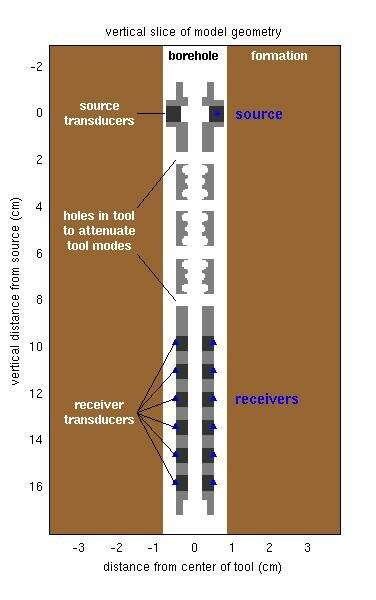 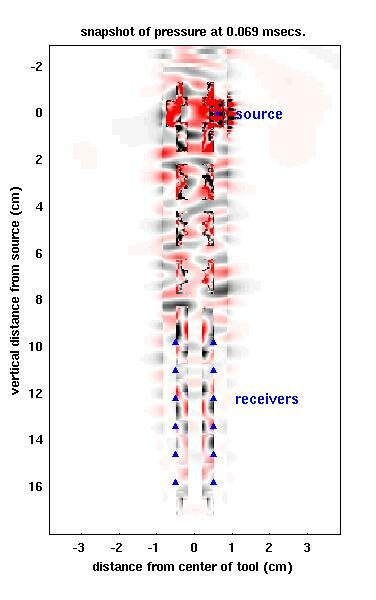 |